Products » Survey Equipment » Innomar Standard
The Innomar Standard is a versatile parametric sub-bottom profiler suitable for both inshore and offshore surveys. Its compact design allows deployment from small survey boats, while its acoustic performance supports operation in water depths of up to 500 metres.
A dual-head option enables the system to operate with two transducers or in single-beam mode with increased range. This flexibility makes the Innomar Standard suitable for a wide variety of geophysical and hydrographic survey applications.
The combination of a high ping rate, small acoustic footprint and broad range of selectable frequencies provides detailed sub-seafloor data with high resolution and effective sediment penetration.
Depending on sediment type and acoustic noise, the system can achieve penetration of up to 50 metres. Multi-ping mode helps maintain a high pulse rate when operating in deeper water.
Electronic beam stabilisation compensates for heave and roll or pitch using information from an external motion sensor. This helps reduce the effects of vessel movement and supports consistent data quality in challenging weather and sea conditions.
The Innomar Standard records 24-bit full-waveform sub-bottom data in SES3 format. Data can be converted to SEG-Y using SESconvert and processed with compatible seismic software.
Innomar’s ISE software provides a dedicated workflow for processing, visualising and interpreting data acquired with Innomar sub-bottom profilers.
The system is operated through SESWIN, Innomar’s Windows-based acquisition and control software. SESWIN supports network operation and remote data visualisation, allowing the system to be integrated into wider survey workflows.
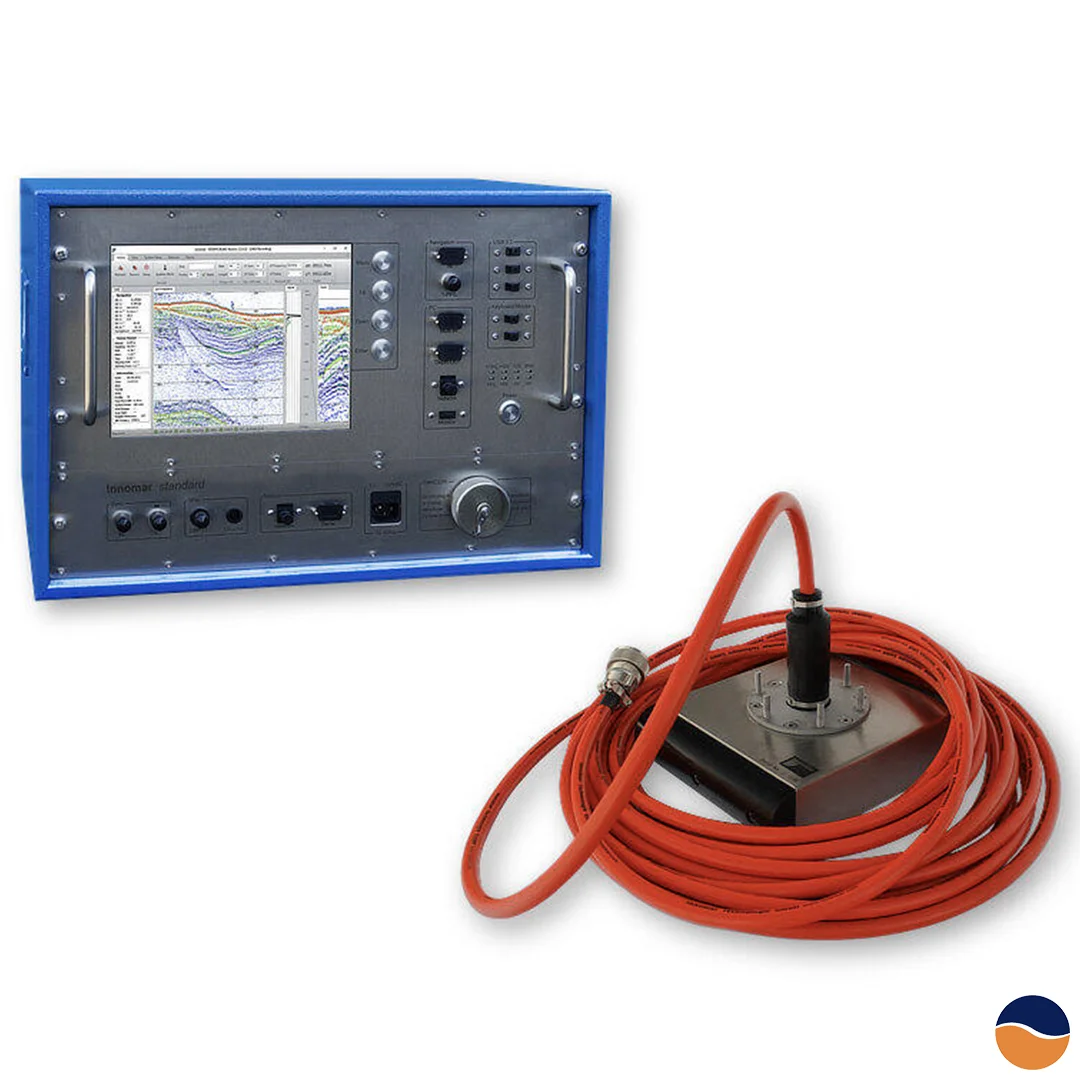
The topside transceiver includes a Windows 10 or 11 computer with a 10-inch TFT display. Basic functions can be controlled remotely through COM or UDP, while optional extended Ethernet control provides access to all survey settings.
| General specification | Value |
|---|---|
| Water-depth range | 0.5–500 m below the transducer |
| Sediment penetration | Up to 50 m, depending on sediment type and noise |
| Sample resolution | Less than 1 cm |
| Range resolution | Up to 5 cm, depending on pulse settings |
| Transmit beam width at −3 dB | Approximately 4° × 4° at all frequencies |
| Acoustic footprint | Approximately 7% of water depth |
| Ping rate | Up to 50 Hz; multi-ping mode available |
| Motion compensation | Heave and roll or pitch using external sensor data |
| Primary frequency | Approximately 100 kHz; frequency band 85–115 kHz |
| Primary-frequency source level | Approximately 241 dB peak / 235 dB RMS re 1 µPa at 1 m |
| Selectable secondary frequencies | 4, 5, 6, 8, 10, 12 or 15 kHz |
| Secondary-frequency band | 2–22 kHz |
| Secondary-frequency pulse types | Ricker, CW and FM chirp |
| CW pulse width | User-selectable from 0.07 to 1.0 ms |
| Chirp pulse width | 1.5 ms |
| Data acquisition | Digital 24-bit at 96 kHz |
| Recorded data | SLF full waveform and PHF envelope |
| File formats | Innomar SES3; SEG-Y through SESconvert |
| External sensor interfaces | HRP motion, GNSS position and depth via RS-232 or UDP; BNC trigger |
| Bottom detection | Internal using PHF or SLF data, or external depth input |
| Depth accuracy | 2 cm at 100 kHz or 4 cm at 10 kHz, plus 0.06% of water depth |
| Remote control | KVM; basic COM or UDP control; NMEA; optional extended Ethernet control |
| Transducer installation | Over-the-side or hull-mounted |
| Transducer depth rating | Surface deployment |
| Power supply | 100–240 V AC using a 16 A slow-blow fuse |
| Optional power supply | External 12 or 24 V DC inverter |
| Power consumption | Approximately 150 W typical; 300 W maximum |
| Control and storage | Integrated Windows 10/11 PC with 10-inch TFT display |
| First/latest generation | 1997 / 2026 |
Enter your details to receive our latest news and events: