Products » Survey Equipment » Innomar Sixpack SBP
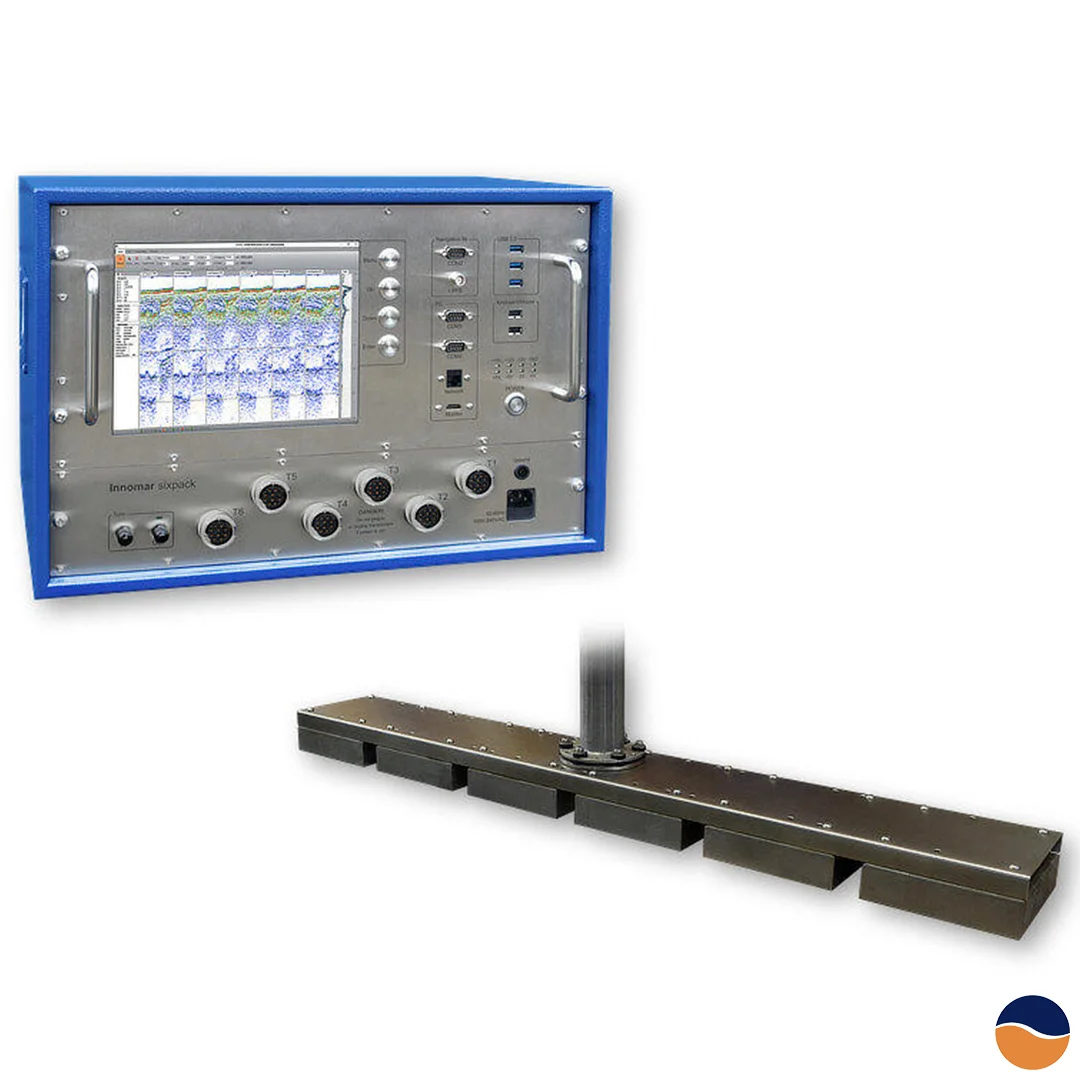
The Innomar Sixpack is a multi-transducer sub-bottom profiler designed to collect very high-density data in extremely shallow water. Its six-transducer configuration makes it particularly suitable for pipeline and cable surveys, offshore construction risk mitigation and marine archaeological investigations.
The system can operate with individual transducers or with all six transducers arranged as a 2 × 3 matrix. This provides flexibility for detailed shallow-water mapping as well as surveys requiring greater water-depth range and sediment penetration.
In multi-transducer mode, the system achieves ping rates of up to 15 Hz. When operated in single-beam mode, ping rates of up to 60 Hz are possible.
Depending on the selected configuration and environmental conditions, the system provides sediment penetration of up to 20 metres with one transducer or up to 60 metres with a 2 × 3 transducer matrix.
Heave compensation can be applied using data from an external motion sensor. Roll and pitch corrections can be performed during post-processing, helping compensate for vessel movement and improve the consistency of collected data.
The Innomar Sixpack records 24-bit full-waveform sub-bottom data in SES3 format. Data can be converted to SEG-Y using SESconvert and processed with compatible seismic software.
Innomar’s ISE software provides a dedicated workflow for processing and interpreting Innomar SBP data. A separate gridding tool and compatible third-party visualisation software can be used to create three-dimensional representations of the sub-bottom dataset.
The topside transceiver includes a Windows 10 or 11 computer with a 10-inch TFT display. Basic SESWIN functions can be controlled remotely through COM or UDP, supporting integration with survey systems and vessel workflows.
| Specification | Single transducer | 2 × 3 transducer matrix |
|---|---|---|
| Water-depth range | 0.5–100 m | 2–1,000 m |
| Sediment penetration | Up to 20 m | Up to 60 m |
| Transmit beam width at −3 dB | Approximately ±2.5° | Approximately ±1.5° |
| PHF source level | Approximately 235 dB re 1 µPa at 1 m | Approximately 247 dB re 1 µPa at 1 m |
Sediment penetration depends on sediment type, acoustic noise and other operating conditions.
| General specification | Value |
|---|---|
| Sample resolution | Less than 1 cm |
| Range resolution | Up to 5 cm, depending on pulse settings |
| Ping rate | Up to 15 Hz in multi-transducer mode; up to 60 Hz in single-beam mode |
| Motion compensation | Heave using external sensor data; roll and pitch in post-processing |
| Primary frequency | Approximately 100 kHz; frequency band 85–115 kHz |
| Selectable secondary frequencies | 4, 5, 6, 8, 10, 12 or 15 kHz |
| Secondary-frequency band | 2–22 kHz |
| Secondary-frequency pulse types | Ricker and CW |
| CW pulse width | User-selectable from 0.07 to 1.0 ms |
| Data acquisition | Digital 24-bit at 96 kHz |
| Recorded data | SLF full waveform and PHF envelope |
| File formats | Innomar SES3; SEG-Y through SESconvert |
| External sensor interfaces | HRP motion, GNSS position and depth via RS-232 or UDP; BNC trigger |
| Bottom detection | Internal using PHF or SLF data, or external depth input |
| Depth accuracy | 3 cm at 100 kHz or 6 cm at 10 kHz, plus 0.1% of water depth |
| Remote control | KVM; basic COM or UDP control; NMEA |
| Transducer depth rating | Surface deployment |
| Power supply | 100–240 V AC |
| Optional power supply | External 12 or 24 V DC inverter |
| Power consumption | Less than 350 W |
| Control and storage | Integrated Windows 10/11 PC with 10-inch TFT display |
| First/latest generation | 2017 / 2021 |
The system includes six transducers. Each unit has the following specifications:
Enter your details to receive our latest news and events: