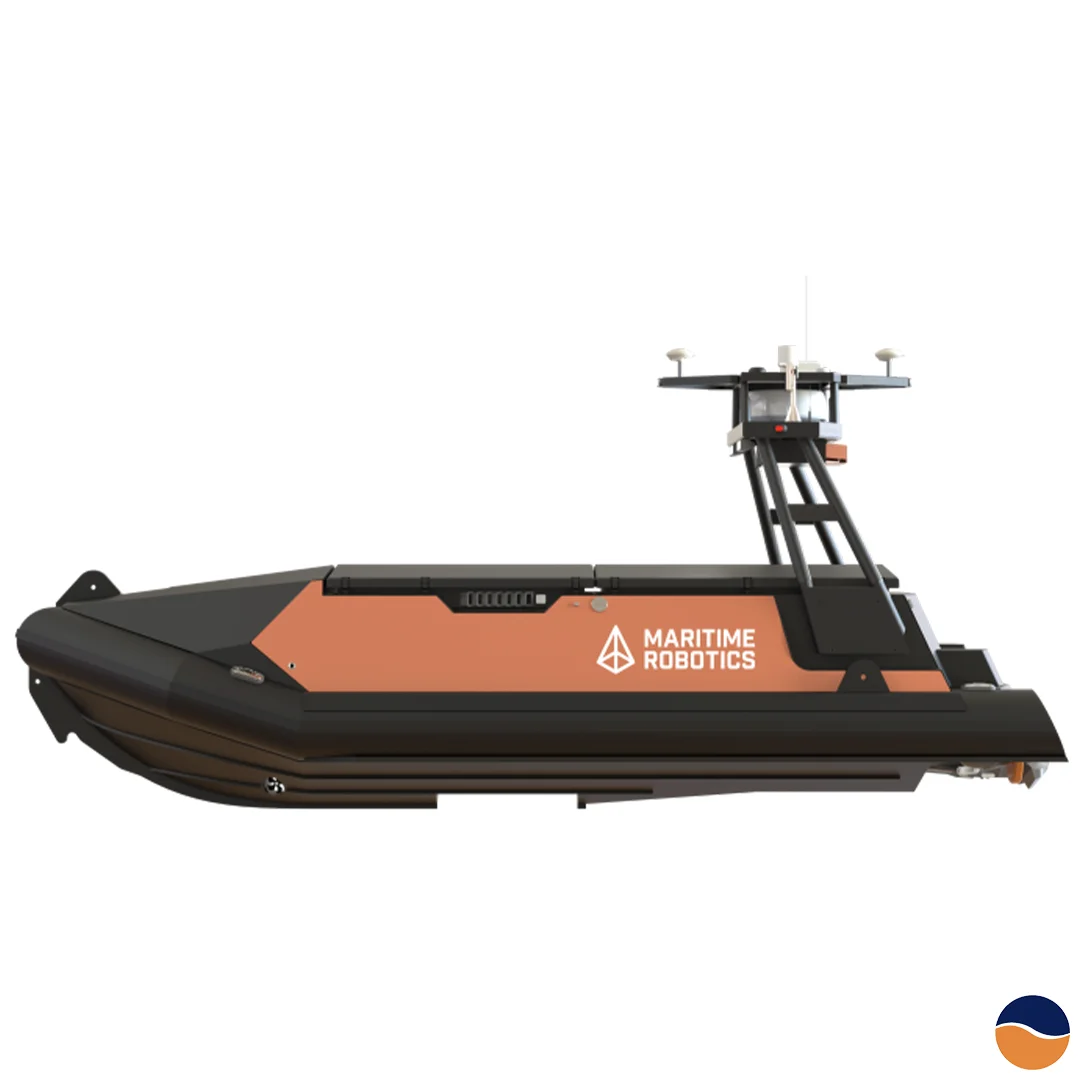
The Mariner is a mid-sized uncrewed surface vessel (USV) developed by Maritime Robotics for hydrographic surveying, environmental monitoring, inspection and maritime surveillance.
Designed for both autonomous and remote-controlled operation, the Mariner extends the reach of survey and monitoring teams while reducing the need to place personnel in remote or hazardous environments. Its modular payload capacity, robust construction and flexible communications make it suitable for missions ranging from shallow coastal surveys to offshore operations.
The Mariner can be incorporated into existing fleets to expand survey, monitoring and exploration capabilities. Autonomous and remote-control modes allow operators to select the most suitable approach for each mission.
For surveillance and environmental monitoring, the USV can act as a force multiplier by covering additional areas, improving situational awareness and reducing operational risk. Its compact dimensions and manoeuvrability also provide access to confined or shallow locations that may be difficult for conventional survey vessels.
A payload capacity of up to 400 kg enables the Mariner to carry a wide range of surface and subsurface sensors. Payloads can be installed using fixed gondolas or an optional retractable moonpool elevator.
The moonpool elevator protects sensors during transport, launch and recovery. Once the vessel reaches the survey area, the sensor gondola can be lowered outside the hull’s bubble stream, supporting cleaner acoustic measurements and improved data quality.
Compatible survey payloads include:
Sensors can be integrated with the vessel and its autonomous navigation system, providing operators with an accessible interface for mission control and data acquisition.
The Mariner is manufactured from rugged, lightweight polyethylene. This stable and low-maintenance construction is designed for repeated operations in coastal and offshore environments.
Its shallow draught supports operation in restricted waters, while the durable hull helps simplify long-term maintenance and vessel management.
Waterjet propulsion and bow thrusters provide accurate low-speed control for survey lines, inspections and close-range operations. Optional redundant propulsion can provide additional operational reliability for demanding or remote missions.
With a top speed of up to 24 knots, the Mariner can also transit efficiently between operating areas.
Standard high-bandwidth LTE connectivity supports data transfer between the vessel, shore stations and other platforms. Optional maritime broadband radio and Starlink connections can extend communications for offshore missions.
The Mariner can be equipped with radar, cameras, AIS and VHF communication to detect and track vessels or other objects. Enhanced SeaSight functionality provides additional situational awareness for remote and autonomous operations.
The Mariner and its associated operational equipment fit inside a standard 40-foot shipping container, supporting transportation between project locations.
The vessel can be launched and recovered with a standard boat trailer or an optional Launch and Recovery System (LARS) cradle. The custom cradle uses a locking mechanism to capture and secure the vessel during deployment and recovery.
| Specification | Value |
|---|---|
| Dry weight | 2,000 kg |
| Top speed | Up to 24 kn |
| Endurance | Up to 50 hours at 4 kn |
| Payload capacity | Up to 400 kg |
| Standard communication | LTE/4G |
| Standard situational awareness | Camera, AIS Class B and radar |
| Transport | Standard 40-foot container |
Performance depends on operating conditions and installed payloads.
Enter your details to receive our latest news and events: